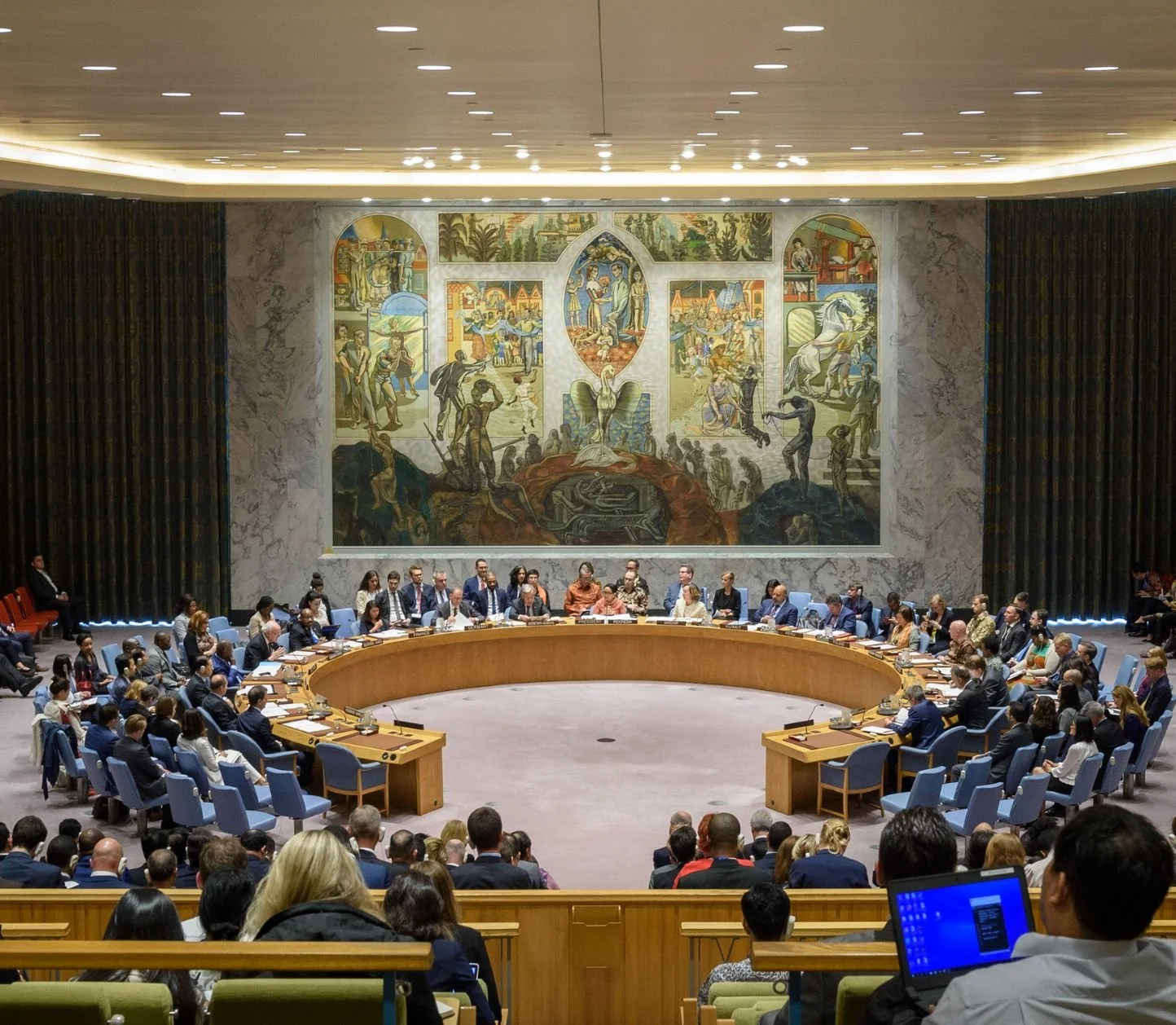
Security Council (UNSC) Details
What Is Security Council?
The United Nations Security Council (UNSC) is the most important committee of the United Nations, primarily responsible for maintaining international peace and security. It has the authority to determine the existence of a threat to peace, introduce methods for peaceful resolution of disputes, and take enforcement measures such as sanctions or military action. The Council is composed of 15 members, including five permanent members with veto power: China, France, Russia, the United Kingdom, and the United States, alongside ten non-permanent members elected for two-year terms. The UNSC plays an existential role in addressing global conflicts, preventing wars, and promoting diplomatic solutions under the framework of international law.
Topics
Addressing the potential ceasefire of the Russo-Ukrainian war
Since February 2022, the Russian Federation has launched a full-scale invasion of Ukraine, widely condemned as a violation of international law, with the official objective of “de-nazifying” and de-militarising Ukraine. The war has led to the death of hundreds of thousands of civilians and military personnel, with extreme devastation to Ukraine’s critical and basic infrastructures. 20 per cent of Ukrainian territories are currently occupied as the two sides engage in active combat. Ukraine is currently waging a hybrid warfare mainly through drones, against Russia's bases, oil refineries, critical energy, transportation, and electricity infrastructure. Depleting Russia’s dwindling resources and economic output.
The Western alliance, including the US, NATO, EU, and allies around the world, united under former president Joe Biden to provide tens of billions worth of military, financial, and intelligence aid. Russia’s war objective remains the capitulation of Ukraine and its full occupation, justifying its war through the threat of NATO expansion. However, President Putin’s ultra-nationalist ambitions in former soviet republics remain the root cause of the war. Bringing an end to said conflict needs to address the interests of the 4 main camps in addition to that of Russia and Ukraine.
Firstly, European allies, with their hope in one day incorporating Ukraine as a member of the EU, view the war as Russian imperialist aggression existential to the security of Europe and its democratic institutions, and stress the need for security guarantees. Europe is ramping up armament as we speak. Secondly, the United States under President Trump, in a flip-flop style of peace negotiation with Putin, is offering conditional Ukraine support and eyeing the Nobel Peace Prize. Fourthly, global south players such as China and India that purchase enormous sums of Russian fossil fuel while offering logistical support. The delegates need to navigate the intricacies of international relations and power dynamics to negotiate a just and lasting peace in Ukraine.
Addressing the Gaza peace process, reconstruction efforts, and accountability for genocide and war crimes
Since October 7th, events in Gaza have resulted in the deaths of tens of thousands of civilians, with the Israeli Defense Forces under the Netanyahu government responsible for the vast majority of the destruction that followed the Hamas attack on Israeli civilians. An estimated 80–90 percent of the Gaza Strip has been destroyed, with civilian neighborhoods, hospitals, schools, and essential infrastructure systematically reduced to rubble. UN experts, international jurists, and human-rights organizations have documented widespread violations of international law, with multiple authoritative bodies explicitly characterizing Israel’s conduct as genocide, including in proceedings before the International Court of Justice. Children have suffered disproportionately, leading Gaza to be described as a graveyard of children. Prolonged restrictions on food, water, medical aid, and fuel have driven the territory into Level 5 famine conditions, while disease, displacement, and the collapse of healthcare systems continue to claim civilian lives. Throughout this period, Israel has received sustained political, military, and intelligence support from Western allies, particularly the United States, despite mounting international condemnation.
Global backlash has led to expanded recognition of Palestinian statehood by several states. Temporary ceasefires have repeatedly been broken by Israel rather than merely collapsing, with Israeli forces resuming attacks, imposing conditions that made pauses unviable, and targeting civilian areas and infrastructure during supposed lulls. Israeli military operations have also expanded beyond Gaza to strike targets linked to Iran and affiliated groups in southern Lebanon, Palestine, and Yemen, further destabilizing the region and entrenching an already grave humanitarian and geopolitical crisis. The United States has played a central role in enabling these actions through extensive military, intelligence, logistical, and diplomatic support, supplying weapons, funding, and political cover that have been critical to sustaining Israel’s campaign.